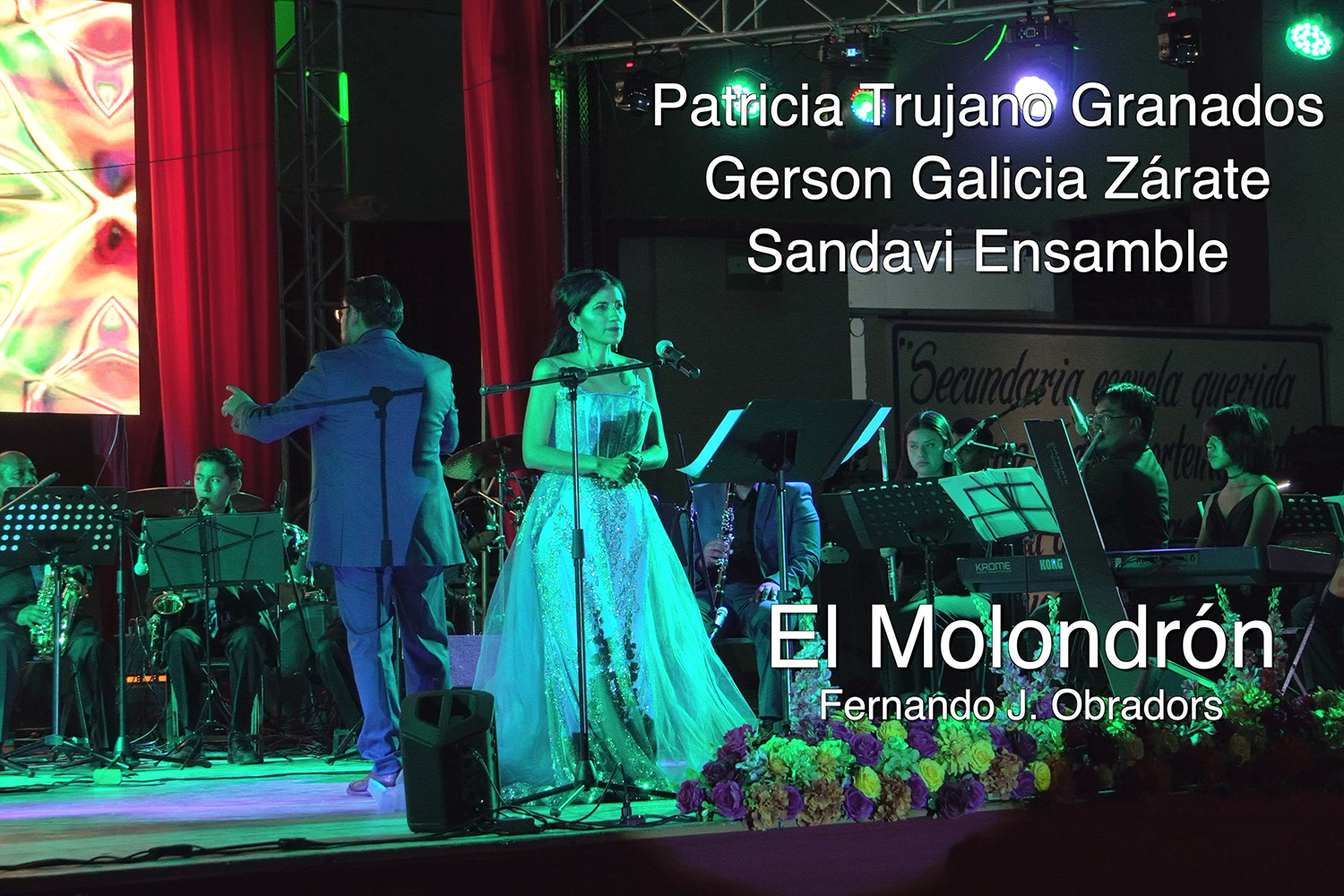
del Concierto de Gala en Huajapan de León/ Oaxaca, con Sandavi Ensamble/ Gerson Galicia Zárate. En el Concierto organizado por la Asociación Civil: Amigos del Arte, I sing and recite poetry in December of 2025, I performed:
'El molondrón', a popular song of Spanish origin that was arranged by Fernando J. Obradors and published in his collection Classical Spanish Songs, Vol. 4 in 1941. on this occasion, We live a very special version thanks to the arrangement made by maestro Gerson Galicia Zárate, who managed to maintain the Spanish essence of the work, but at the same time fill it with colors and nuances that evoke our Oaxacan dances..
I was very happy to share the stage with the talent, the delivery and commitment of “Sandavi Ensemble”, who worked with dedication and dedication so that everything went very well.
Infinite thanks also to those who made it possible to capture this special moment.: Alexander Uhl, Monica Arias and Ariadna Lara
Share this music at home, in my homeland, with my people, It has been an immense gift. I hope you enjoy it as much as I experienced it.
ideo
El Molondrón – Fernando J. Workshops
Fernando Jaumandreu Obradors, born in 1897 in Barcelona and passed away in the same city in 1945, was one of those composers who make history without the world noticing too much. His life path was far from linear: he learned composition, harmony, and counterpoint largely on his own – a high-level self-taught path. Later he studied in Paris, survived the Spanish Civil War, conducted in Barcelona and ended up in the Canary Islands, where he was director of the Gran Canaria Philharmonic Orchestra and a teacher at the Las Palmas Conservatory. His stage works fell into oblivion. What endured are theClassical Spanish Songs – four volumes of arrangements of popular Spanish songs, created between 1921 y 1941, with piano accompaniments so ingenious that the original melodies literally bloom anew.
El Molondrón belongs to the fourth and final volume of this collection. The title alone is already a small curiosity: according to the Royal Spanish Academy, molondrón means, on one hand, the same asmolondro – that is, a lazy and clumsy man –, and on the other, especially in Andalusia, a blow to the head or with the head.
Obradors set the text to music in a light and folkloric way, with chorus and repeated motifs, typical of his collection of classical Spanish songs. It reflects rural life, rogueish and provincial which characterizes a good part of his work.
The text itself is an anonymous folk song set around a miller and his mill. The word itself sounds almost onomatopoeic – like a dull and clumsy blow. Accordingly, the text overflows with sly humor: a young woman confesses that she went to visit the miller secretly at night – and that as a result, she had to deal with her father, her mother and her grandfather. What else was lost besides the skirts and the handkerchief, the text prefers not to recall it in too much detail. Obradors carries all this roguish popular humor with an accompaniment of elastic and lively piano, that evokes the pounding rhythm of the mill – and makes as if such a story, with all its impudence, It was the most innocent thing in the world.